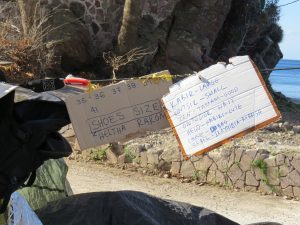
This is what my daughter jokingly told me after spending 12 hours in the women’s clothing tent, at the self-organized Platanos camp in Skala Sikamenias Lesbos. She had spent our first day here having helped fold and organize clothes and then working with women to find appropriate clothes among the sorted boxes and piles of donations and change into dry and warm clothing just after they arrived off the boats during the day and the night.
It sounded funny at the moment but it took a few days for the full significance of that comment to sink in with me. That she said “I could work in retail” and not “I could work in a shelter” or “I could work with an aid or a philanthropic organization.”
We always say that we do “solidarity, not charity” but the difference is sometimes hard to explain. The more I thought of her comment though, the more sense it made to me in that context. There is a significantly different relationship that you have with a customer if you work in a retail clothing store than you do with a “client” if you work in a shelter (not to mention power dynamics).
A young greek woman who speaks arabic and who has spent time in the Platanos camp told me, after an assembly, that she had been talking with a few of the people who had arrived at the camp and they too had pointed out to her how differently treated they felt here. “These people have travelled a long way through many different settings to get to this point,” she told me. “They have gone through official refugee camps, detention centers, have been helped by aid organizations large and small, by ordinary folks, by solidarity groups, have been threatened and beaten by police and military, have dealt with smugglers, traffickers, profiteers. Many of them are very educated. They may not have a choice of what help they receive, but they understand the difference.” An Arab woman told her one time “you don’t look like you are acting out of guilt. You don’t have a white saviour complex. You treat us as equals.”
My daughter asks me at some point if she is supposed to feel good about herself doing this work, because she didn’t (she didn’t feel bad either, she felt neutral, and mostly tired). “You are supposed to feel good about yourself” I answered, “but not because you are doing this.”
“Some people back home have said how pitiful those people are coming off the boats, wet, cold, hungry, scared” my daughter replied. “But they weren’t pitiful” she said. “Some of them are appreciative, some of them are demanding, some of them are picky. But none of them were ever pitiful.”
“They are just people” she said. “It is just that their situation sucks.”
There are a lot of different people with a lot of different organizations working in Lesbos, each with their own history, intentions, motivations and values. We are far from the only ones doing good and necessary work and I never want to disparage people who are doing hard work to help and save lives. Nor do I want to imply that everything is ideal in our own little camp. Anyone who has ever been a part of a self-organized and self-managed project knows very well all the problems we deal with, from working with minimal resources, few people and long hours, to all, and I mean ALL, the messiness of human relationships and interactions.
Yet “solidarity, not charity” is not a just a slogan. It is a way in which we try to live our lives and shape our relationships. It is about recognizing our common humanity while also respecting and honoring our differences. It is about choosing to stand together instead of kneeling under, or ruling over. It is not easy, it is never perfect, and we always struggle with tough choices and internalized assumptions and behaviours.
A young scandinavian woman, wearing the vest of her NGO sat next to a group of us at the camp, taking a much needed break after a hard night. She had been heading back to the village after her “shift” had ended, saw that we had about 100+ people who had just gotten off their boats and immediately joined our crew at the kitchen helping to make jam sandwiches. A woman from our group, who had noticed her when she had come to help on previous days as well, asked her why she came to work here when she already did work in the camp of her own NGO. “I like it here” she said. “I am not sure why. But I like how you treat people. And each other.”
Behind us, a few young men in our group were kicking a ball with some of the kids who had come in the boats earlier in the night, laughing and kidding around with each other.”
“I could work in retail.”
This is what my daughter jokingly told me after spending 12 hours in the women’s clothing tent, at the self-organized Platanos camp in Skala Sikamenias Lesbos. She had spent our first day here having helped fold and organize clothes and then working with women to find appropriate clothes among the sorted boxes and piles of donations and change into dry and warm clothing just after they arrived off the boats during the day and the night.
It sounded funny at the moment but it took a few days for the full significance of that comment to sink in with me. That she said “I could work in retail” and not “I could work in a shelter” or “I could work with an aid or a philanthropic organization.”
We always say that we do “solidarity, not charity” but the difference is sometimes hard to explain. The more I thought of her comment though, the more sense it made to me in that context. There is a significantly different relationship that you have with a customer if you work in a retail clothing store than you do with a “client” if you work in a shelter (not to mention power dynamics).
A young greek woman who speaks arabic and who has spent time in the Platanos camp told me, after an assembly, that she had been talking with a few of the people who had arrived at the camp and they too had pointed out to her how differently treated they felt here. “These people have travelled a long way through many different settings to get to this point,” she told me. “They have gone through official refugee camps, detention centers, have been helped by aid organizations large and small, by ordinary folks, by solidarity groups, have been threatened and beaten by police and military, have dealt with smugglers, traffickers, profiteers. Many of them are very educated. They may not have a choice of what help they receive, but they understand the difference.” An Arab woman told her one time “you don’t look like you are acting out of guilt. You don’t have a white saviour complex. You treat us as equals.”
My daughter asks me at some point if she is supposed to feel good about herself doing this work, because she didn’t (she didn’t feel bad either, she felt neutral, and mostly tired). “You are supposed to feel good about yourself” I answered, “but not because you are doing this.”
“Some people back home have said how pitiful those people are coming off the boats, wet, cold, hungry, scared” my daughter replied. “But they weren’t pitiful” she said. “Some of them are appreciative, some of them are demanding, some of them are picky. But none of them were ever pitiful.”
“They are just people” she said. “It is just that their situation sucks.”
There are a lot of different people with a lot of different organizations working in Lesbos, each with their own history, intentions, motivations and values. We are far from the only ones doing good and necessary work and I never want to disparage people who are doing hard work to help and save lives. Nor do I want to imply that everything is ideal in our own little camp. Anyone who has ever been a part of a self-organized and self-managed project knows very well all the problems we deal with, from working with minimal resources, few people and long hours, to all, and I mean ALL, the messiness of human relationships and interactions.
Yet “solidarity, not charity” is not a just a slogan. It is a way in which we try to live our lives and shape our relationships. It is about recognizing our common humanity while also respecting and honoring our differences. It is about choosing to stand together instead of kneeling under, or ruling over. It is not easy, it is never perfect, and we always struggle with tough choices and internalized assumptions and behaviours.
A young scandinavian woman, wearing the vest of her NGO sat next to a group of us at the camp, taking a much needed break after a hard night. She had been heading back to the village after her “shift” had ended, saw that we had about 100+ people who had just gotten off their boats and immediately joined our crew at the kitchen helping to make jam sandwiches. A woman from our group, who had noticed her when she had come to help on previous days as well, asked her why she came to work here when she already did work in the camp of her own NGO. “I like it here” she said. “I am not sure why. But I like how you treat people. And each other.”
Behind us, a few young men in our group were kicking a ball with some of the kids who had come in the boats earlier in the night, laughing and kidding around with each other.